Core Web Vitals & PageSpeed Insights Optimization Service
Does your site feel snappy on office Wi-Fi yet fail Mobile Google PageSpeed Insights? HeadRandom fixes LCP, INP, CLS, TTFB, and render-blocking bottlenecks at the architectural level so your site achieves genuine 90-100 performance, stays rock-solid on every device, and helps Search Engines and AI Bots crawl and rank your pages faster.
Feels Fast Locally Yet Losing Rankings, Ad ROI, and Mobile PageSpeed?
Even a one-second mobile rendering delay erodes conversions and prevents search engines and AI search crawlers from indexing your pages efficiently.
Green on Desktop, Failing Mobile PageSpeed at 30-50
Unpreloaded hero images, late web fonts, and render-blocking CSS/JS push Mobile LCP to 4-8 seconds on real 4G connections even when desktop fiber opens quickly.
Burning Paid Ad Budgets on Sluggish Landing Pages
Visitors tap an ad and hit frozen UI or delayed button clicks (high INP), spiking bounce rates, lowering Google Ads Quality Score, and inflating CPC costs.
Blind Cache Plugins Breaking Layouts & Conversion Tracking
Turning on aggressive CSS/JS minification without surgical exclusions triggers layout shifts (CLS), breaks WooCommerce checkout scripts, or drops GA4 and Meta Pixel events.
Wasted Crawl Budget Across Googlebot & AI Search Crawlers (GEO)
Slow TTFB, oversized DOM trees, and blocking script chains slow down Googlebot, GPTBot, and PerplexityBot parsing, limiting index coverage and AI citation visibility.
Key Distinction: Raw Load Speed vs Genuine Core Web Vitals
Many teams mistake fast first-byte caching for passing Core Web Vitals. Understanding why these diverge is essential for SEO rankings, GEO visibility, and conversion stability.
1. Fast Raw Speed Does Not Guarantee Good Core Web Vitals
A cached HTML response returning in under a second can still fail Core Web Vitals when an unoptimized hero asset stalls LCP past 2.5s, late web fonts or banners shift text around (CLS > 0.1), or heavy third-party JavaScript delays user taps (INP > 200ms).
2. Passing Core Web Vitals Guarantees Fast, Stable Speed
Truly passing LCP, INP, and CLS requires fixing root performance bottlenecks across server TTFB, Critical CSS, asset prioritization, reserved dimensions, and main-thread JS execution. The result is consistently fast, stable loading that empowers Search Engines and AI Bots to fetch and parse content cleanly for higher rankings.
Superficial Page Caching vs Root-Level Core Web Vitals Optimization for SEO & GEO
|
Engineering Dimension
|
Raw Cache / Superficial Speed Tweaks
Fast FCP only, unstable CWV
|
Full Core Web Vitals Engineering (HeadRandom)
Recommended
LCP + INP + CLS + SEO / GEO
|
|---|---|---|
| Hero Content Paint (LCP) | Fast initial HTML, yet hero media stalls on 4G mobile |
Preloaded LCP <= 2.5s, critical path prioritized above the fold
|
| Visual Layout Stability (CLS) | Missing dimensions and unstyled web fonts shift buttons |
Explicit aspect ratios, font-display: swap, CLS <= 0.1
|
| Interaction Responsiveness (INP / TBT) | Long JS tasks freeze menus, filters, and checkout taps |
Split & defer non-critical JS, free main thread, TBT ~ 0 ms
|
| Server & Backend Consistency (TTFB) | Breaks down under uncached queries or traffic spikes | OPcache tuning, SQL profiling, HTTP cache headers, Brotli |
| Search Engine & AI Bot Parsing (GEO) | Bloated DOM and blocking scripts waste crawl budget |
Lean semantic HTML, Agentic Browsing 2/2, deeper faster indexing
|
| Long-Term Ranking & Ad ROI Impact | Regresses quickly as new content or pixels are added | Guaranteed fast, stable real-world speed across Mobile & Desktop |
When LCP, INP, and CLS are engineered cleanly across Lab and Field data, fast real-world loading speed follows automatically.
Verified Live Proof on Google PageSpeed Insights
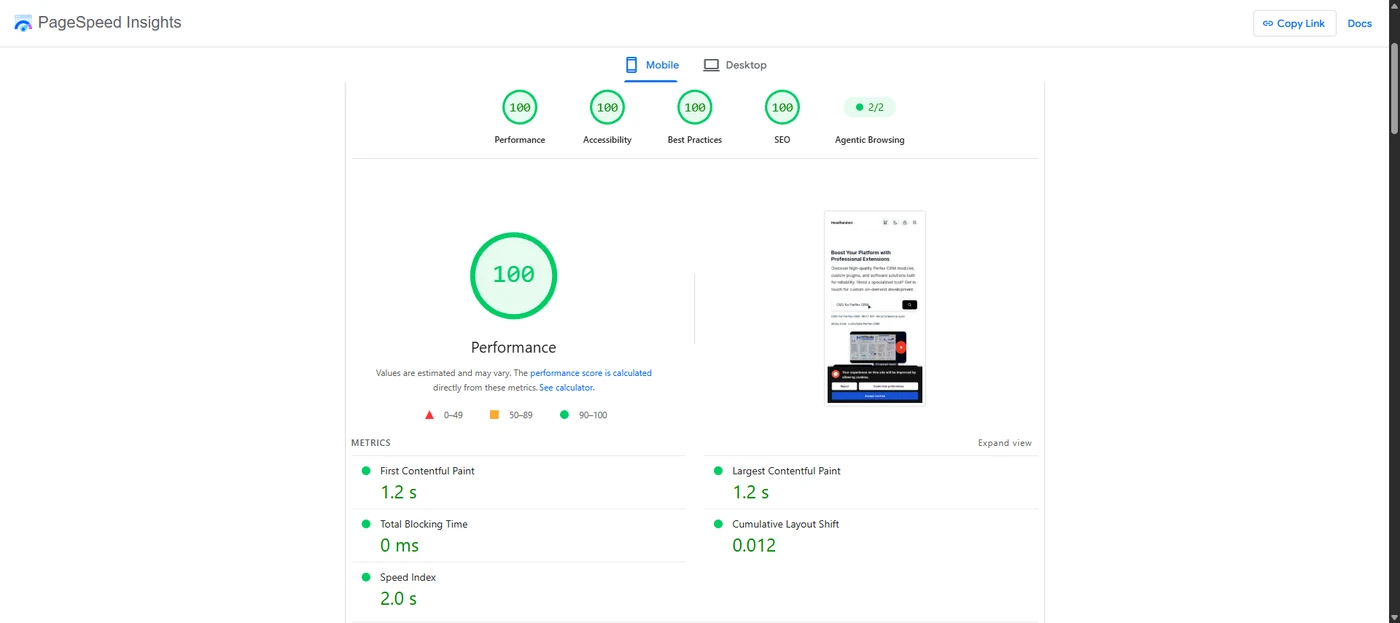
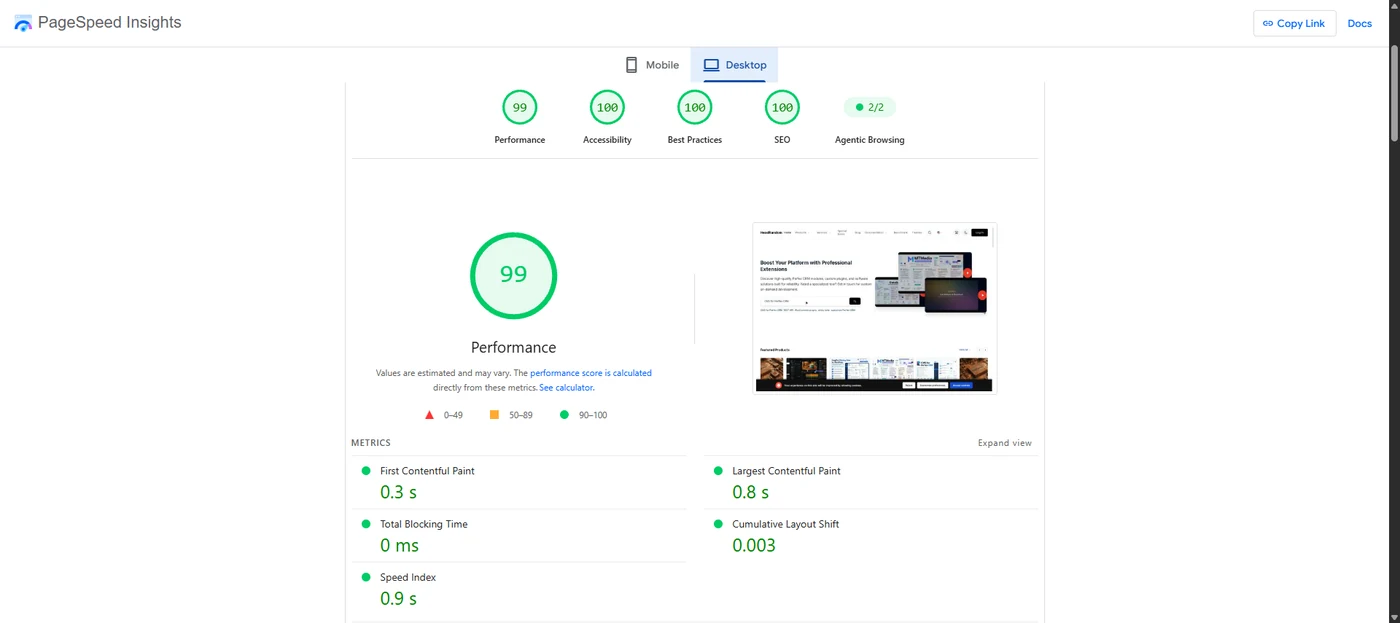
Real unedited Lighthouse 13.6.0 captures recorded on Nov 27, 2026 across live systems engineered by HeadRandom. Click either report link to re-verify directly on pagespeed.web.dev.
headrandom.com
Scores a spotless 100/100/100/100 on Mobile and 99/100/100/100 on Desktop with Agentic Browsing 2/2, enabling instant parsing by both Googlebot and AI search crawlers (0.3s Desktop FCP, 0 ms blocking time).
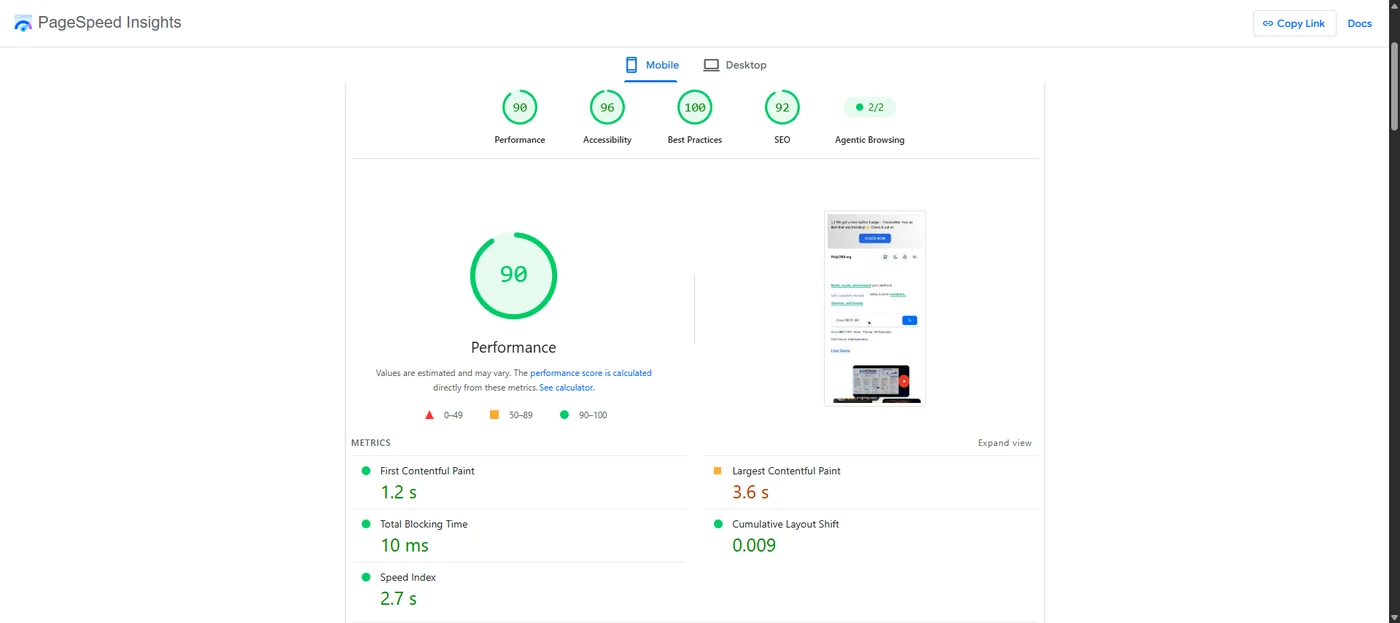
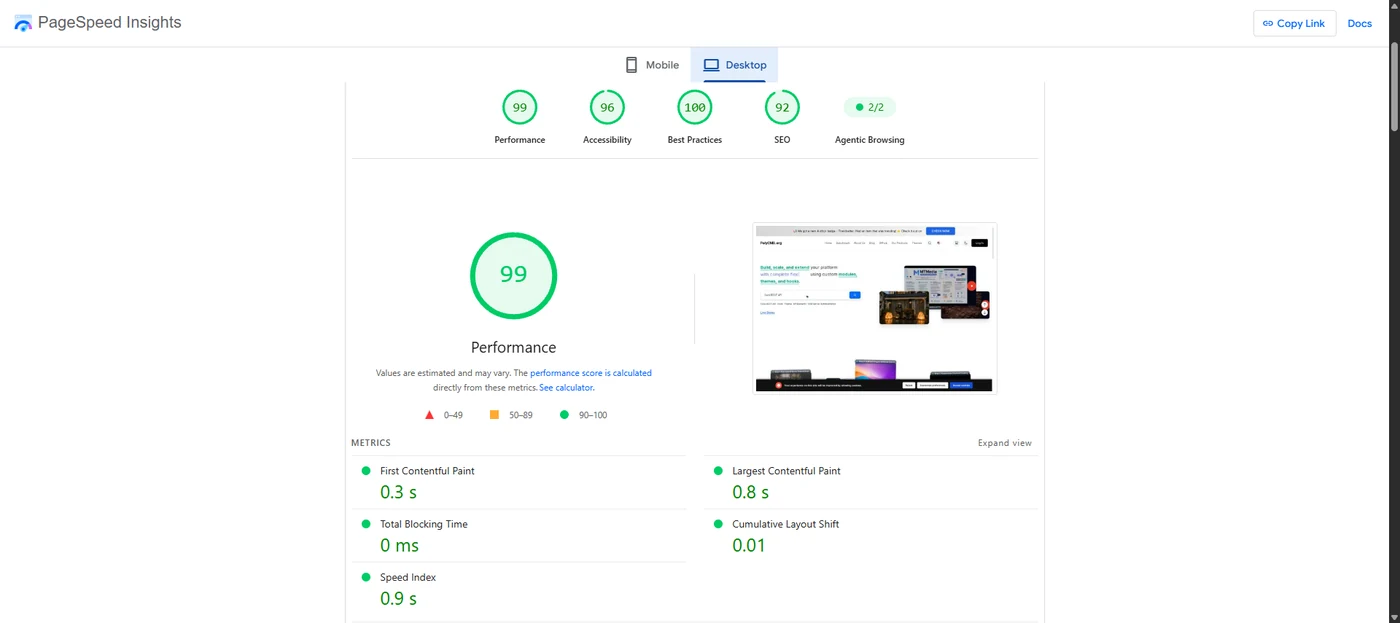
polycms.org
Achieves 99 Performance on Desktop (0.3s FCP, 0.8s LCP, 0 ms TBT, Agentic Browsing 2/2). Notably on Mobile, despite a fast 1.2s FCP, 10 ms TBT, and 90 overall score, Mobile LCP sits at 3.6 s - a real example proving why fast initial speed still requires dedicated LCP tuning to clear all Core Web Vitals thresholds cleanly.
Core Metrics HeadRandom Optimizes and Why Every Millisecond Counts
Coordinated engineering across server backend, caching headers, front-end critical path, and search crawlability.
LCP (Largest Contentful Paint <= 2.5s)
Measures how quickly the primary above-the-fold hero image or heading renders visibly for users.
- Convert hero media to WebP/AVIF sized accurately per viewport
- Add
fetchpriority="high"& preload LCP assets while excluding them from lazy-loading - Eliminate render-blocking CSS/JS and cut server TTFB latency
INP (Interaction to Next Paint <= 200ms)
Replaces FID to measure real responsiveness across menu taps, filters, form inputs, and checkout clicks.
- Break up JavaScript Long Tasks blocking the browser main thread
- Schedule analytics/chat third-party scripts safely without losing conversion events
- Trim bloated DOM node depth for snappier interaction frames
CLS (Cumulative Layout Shift <= 0.1)
Prevents unexpected page jumps during loading that cause mis-clicks and poor mobile UX.
- Enforce explicit
width,height, andaspect-ratioacross images, embeds, and sliders - Reserve slots for banners and configure self-hosted fonts (
font-display: swap) - Stop dynamic above-the-fold injections from pushing content downward
TTFB, FCP & Backend Server Tuning
Fast Time to First Byte sets the ceiling for every visual metric and sustains high concurrent traffic.
- Deploy smart full-page caching (OpenLiteSpeed LSCache, Nginx FastCGI, Redis)
- Tune PHP OPcache, resolve slow SQL queries, and prune bloated autoloaded rows
- Enable Brotli/Gzip compression, HTTP/2-HTTP/3, and immutable asset headers
SEO Rankings & Ads Quality Score
Core Web Vitals directly feed Google's Page Experience ranking systems and ad landing relevance.
- Strengthen mobile ranking resilience in competitive SERPs
- Cut mobile bounce rates and boost checkout conversion completion
- Improve landing page experience inside Google Ads to lower cost per click
GEO & AI Search Bot Crawling
AI crawlers favor fast, clean, deterministic HTML payloads free from script bottlenecks.
- Help Googlebot, GPTBot, and PerplexityBot index deeper within your crawl budget
- Deliver structured semantic HTML that LLMs parse cleanly into citations
- Meet Agentic Browsing 2/2 readiness for modern AI web agents
Platform-Specific Optimization Engineering
Select your web stack to inspect the exact optimizations HeadRandom delivers.
- Strip site-wide plugin CSS/JS bloat per route and extract clean Critical CSS for above-the-fold rendering.
- Convert images to WebP/AVIF, preload hero LCP assets, and prevent lazy-loading mistakes on the first screen.
- Clean up bloated wp_options autoload rows, optimize WooCommerce Cart Fragments & Redis Object Cache.
- Configure exact cache exclusions for cart, checkout, and account routes while preserving GA4 and Meta Pixel.
Transparent Pricing Scaled to Your Site Architecture
Fixed scope quotes confirmed after HeadRandom reviews your live PageSpeed Insights report at zero upfront audit cost.
CWV Audit & Quick-Win Optimization
Ideal for blogs, service sites, and landing pages needing immediate WebP media fixes, LCP preload, CLS stabilization, and clean page caching.
- Deep bottleneck audit across LCP, INP, CLS & Waterfall
- Convert images to WebP, preload LCP, and fix CLS layout shifts
- Configure Page Cache, Brotli/Gzip, and asset delivery
- Before/after PageSpeed Insights verification report
Full Core Web Vitals 90-100 Optimization
Complete architectural optimization spanning Critical CSS, main-thread JavaScript splitting for INP/TBT, SQL profiling, and GEO-ready HTML cleanup.
- Optimize LCP, INP, CLS, FCP & TTFB on both Mobile & Desktop
- Audit heavy plugins/themes and strip unused CSS/JS per route
- Enhance Search Engine & AI Bot crawl efficiency (GEO)
- Full QA of forms, cart/checkout, and GA4/Pixel tracking
E-Commerce, Complex Stack & CrUX 28-Day
Tailored for high-SKU WooCommerce stores, AJAX filters, Perfex/RISE CRM portals, or Laravel/Next.js apps targeting 28-day CrUX Field Data compliance.
- SQL query tuning, Redis Object Cache, OLS/Nginx & CDN rules
- Eliminate complex JS Long Tasks across checkout and pricing pages
- 28-day Search Console Core Web Vitals field monitoring
- Editorial handover guide to keep new posts green
4-Step Zero-Downtime Speed Optimization Workflow
Every adjustment is backed up and staged safely before touching live production traffic.
Live PSI & Waterfall Diagnosis
Profile PageSpeed Insights Mobile/Desktop, server TTFB, SQL timing, and blocking third-party scripts.
Backup & Server Stack Tuning
Create full backups, enable HTTP/2-HTTP/3, Brotli, OPcache, Redis, and safe dynamic page cache rules.
LCP, INP, CLS & Asset Surgery
Deploy WebP/AVIF, preload hero LCP, inline Critical CSS, lock image dimensions, and defer non-critical JS.
Live Verification & Handover
Re-test publicly on pagespeed.web.dev, verify checkout/forms/pixels on mobile, and document ongoing maintenance.
Frequently Asked Questions About Core Web Vitals Optimization
Clear engineering answers before optimizing your live site.
Save 30% Bundle: Pair Core Web Vitals With SEO / GEO Website Care
Keep your 90-100 PageSpeed scores intact while growing organic rankings with ongoing content, WebP media, and GEO management. Bundle 2 or more HeadRandom services to receive 30% OFF automatically.
Send Your URL for a Free Core Web Vitals Audit
Share your website URL and HeadRandom will diagnose exact LCP, INP, CLS, and TTFB bottlenecks on PageSpeed Insights and outline the fastest optimization plan.
Send your site URL directly (response within 30 mins - 2 hours):
Explore Other Engineering Services at HeadRandom